Monday, 30 January 2017

What is an Octopus??

                                                            OCTOPUS
Octopus2.jpg
             Octopuses are characterized by their eight arms, usually bearing suction cups. The arms of octopuses are often distinguished from the pair of feeding tentacles found in squid and cuttlefish.[18] Both types of limb are muscular hydrostats.
              Octopuses can be divided into two suborders, the Incirrina (or Incirrata) and the Cirrina (or Cirrata). The incirrate octopuses are distinguished from the cirrate octopuses by their absence of "cirri" filaments (found with the suckers), as well as by the lack of paired swimming fins on the head. Unlike most other cephalopods, the majority of octopuses – those in the Incirrina – have almost entirely soft bodies with no internal skeleton. They have neither a protective outer shell like the nautilus, nor any vestige of an internal shell or bones, like cuttlefish or squid. The beak, similar in shape to a parrot's beak, and made of chitin, is the only hard part of their bodies. This enables them to squeeze through very narrow slits between underwater rocks, which is very helpful when they are fleeing from moray eels or other predatory fish. The octopuses in the less-familiar Cirrina suborder have two fins and an internal shell, generally reducing their ability to squeeze into small spaces. These cirrate species are often free-swimming and live in deep-water habitats, while incirrate octopus species are found in reefs and other shallower seafloor habitats.
Octopuses have a relatively short life expectancy, with some species living for as little as six months. Larger species, such as the giant pacific octopus, may live for up to five years under suitable circumstances. However, reproduction is a cause of death: males can live for only a few months after mating, and females die shortly after their eggs hatch. They neglect to eat during the (roughly) one-month period spent taking care of their unhatched eggs, eventually dying of starvation. In a scientific experiment, the removal of both optic glands after spawning was found to result in the cessation of broodiness, the resumption of feeding, increased growth, and greatly extended lifespans.[19]
Grimpoteuthis discoveryi, a finned octopus of the suborder Cirrina
Octopuses have three hearts. Two branchial hearts pump blood through each of the two gills, while the third is a systemic heart that pumps blood through the body. Octopus blood contains the copper-rich protein hemocyanin for transporting oxygen. Although less efficient under normal conditions than the iron-rich hemoglobin of vertebrates, in cold conditions with low oxygen pressure, hemocyanin oxygen transportation is more efficient than hemoglobin oxygen transportation. The hemocyanin is dissolved in the plasma instead of being carried within red blood cells, and gives the blood a bluish color. The octopus draws water into its mantle cavity, where it passes through its gills. As molluscs, octopuses have gills that are finely divided and vascularized outgrowths of either the outer or the inner body surface.

Defense

Greater blue-ringed octopus (Hapalochlaena lunulata)
The octopus's primary defense is to hide or to disguise itself through camouflage and mimicry.[39] Octopuses have several secondary defenses (defenses they use once they have been seen by a predator). The most common secondary defense is fast escape. Other defenses include distraction with the use of ink sacs and autotomising limbs.
Most octopuses can eject a thick, blackish ink in a large cloud to aid in escaping from predators. The main coloring agent of the ink is melanin, which is the same chemical that gives humans their hair and skin color. This ink cloud is thought to reduce the efficiency of olfactory organs, which would aid evasion from predators that employ smell for hunting, such as sharks. Ink clouds of some species might serve as pseudomorphs, or decoys that the predator attacks instead.[40]
The octopus's camouflage is aided by certain specialized skin cells which can change the apparent color, opacity, and reflectivity of the epidermis. Chromatophores contain yellow, orange, red, brown, or black pigments; most species have three of these colors, while some have two or four. Other color-changing cells are reflective iridophores, and leucophores (white).[41] This color-changing ability can also be used to communicate with or warn other octopuses. The highly venomous blue-ringed octopus becomes bright yellow with blue rings when it is provoked. Octopuses can use muscles in the skin to change the texture of their mantle to achieve a greater camouflage. In some species, the mantle can take on the spiky appearance of seaweed, or the scraggly, bumpy texture of a rock, among other disguises. However, in some species, skin anatomy is limited to relatively patternless shades of one color, and limited skin texture. It is thought that octopuses that are day-active and/or live in complex habitats such as coral reefs have evolved more complex skin than their nocturnal and/or sand-dwelling relatives.[39]
When under attack, some octopuses can perform arm autotomy, in a manner similar to the way skinks and other lizards detach their tails. The crawling arm serves as a distraction to would-be predators. Such severed arms remain sensitive to stimuli and move away from unpleasant sensations.[42]
A few species, such as the mimic octopus, have a fourth defense mechanism. They can combine their highly flexible bodies with their color-changing ability to accurately mimic other, more dangerous animals, such as lionfishsea snakes, and eels.[43][44]

Reproduction

When octopuses reproduce, the male uses a specialized arm called a hectocotylus to transfer spermatophores (packets of sperm) from the terminal organ of the reproductive tract (the cephalopod "penis") into the female's mantle cavity.[45] The hectocotylus in benthic octopuses is usually the third right arm. Males die within a few months of mating. In some species, the female octopus can keep the sperm alive inside her for weeks until her eggs are mature. After they have been fertilized, the female lays about 200,000 eggs (this figure dramatically varies between families, genera, species and also individuals).[citation needed]

Cohabitation

Pacific striped octopuses share food and habitation but most other octopuses are solitary outside of mating.[46]

Senses

Octopuses have keen eyesight. Like other cephalopods, they can distinguish the polarization of light. Color vision appears to vary from species to species, being present in O. aegina but absent in O. vulgaris.[47] Attached to the brain are two special organs, called statocysts, that allow the octopus to sense the orientation of its body relative to horizontal. An autonomic response keeps the octopus's eyes oriented so the pupil slit is always horizontal.[citation needed]
Octopuses also have an excellent sense of touch. The octopus's suction cups are equipped with chemoreceptors so the octopus can taste what it is touching. The arms contain tension sensors so the octopus knows whether its arms are stretched out. However, it has a very poor proprioceptive sense. The tension receptors are not sufficient for the brain to determine the position of the octopus's body or arms. (It is not clear whether the octopus brain would be capable of processing the large amount of information that this would require; the flexibility of the octopus's arms is much greater than that of the limbs of vertebrates, which devote large areas of cerebral cortex to the processing of proprioceptive inputs.) As a result, the octopus does not possess stereognosis; that is, it does not form a mental image of the overall shape of the object it is handling. It can detect local texture variations, but cannot integrate the information into a larger picture.[48]

What is a Venus Fly Trap??

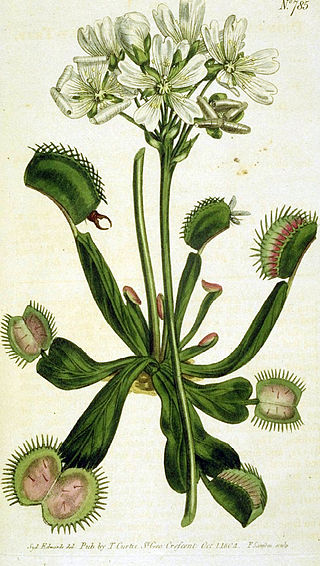
                             Venus Fly Trap
                                    Image result for venus fly trap
       The Venus flytrap (also referred to as Venus's flytrap or Venus' flytrap), Dionaea muscipula, is a carnivorous plant native to subtropical wetlands on the East Coast of the United States in North Carolina and South Carolina. It catches its prey—chiefly insects and arachnids—with a trapping structure formed by the terminal portion of each of the plant's leaves, which is triggered by tiny hairs on their inner surfaces. When an insect or spider crawling along the leaves contacts a hair, the trap prepares to close, snapping shut only if another contact occurs within approximately twenty seconds of the first strike. The requirement of redundant triggering in this mechanism serves as a safeguard against wasting energy by trapping objects with no nutritional value, and the plant will only begin digestion after five more stimuli to ensure it has caught a live bug worthy of consumption.

       The Venus flytrap is a small plant whose structure can be described as a rosette of four to seven leaves, which arise from a short subterranean stem that is actually a bulb-like object. Each stem reaches a maximum size of about three to ten centimeters, depending on the time of year;[4] longer leaves with robust traps are usually formed after flowering. Flytraps that have more than seven leaves are colonies formed by rosettes that have divided beneath the ground.

                                                              
        The leaf blade is divided into two regions: a flat, heart-shaped photosynthesis-capable petiole, and a pair of terminal lobes hinged at the midrib, forming the trap which is the true leaf. The upper surface of these lobes contains red anthocyanin pigments and its edges secrete mucilage. The lobes exhibit rapid plant movements, snapping shut when stimulated by prey. The trapping mechanism is tripped when prey contacts one of the three hair-like trichomes that are found on the upper surface of each of the lobes. The mechanism is so highly specialized that it can distinguish between living prey and non-prey stimuli, such as falling raindrops; two trigger hairs must be touched in succession within 20 seconds of each other or one hair touched twice in rapid succession, whereupon the lobes of the trap will snap shut, typically in about one-tenth of a second. The edges of the lobes are fringed by stiff hair-like protrusions or cilia, which mesh together and prevent large prey from escaping. These protrusions, and the trigger hairs (also known as sensitive hairs) are likely homologous with the tentacles found in this plant’s close relatives, the sundews. Scientists have concluded that the snap trap evolved from a fly-paper trap similar to that of Drosera.
         The holes in the meshwork allow small prey to escape, presumably because the benefit that would be obtained from them would be less than the cost of digesting them. If the prey is too small and escapes, the trap will usually reopen within 12 hours. If the prey moves around in the trap, it tightens and digestion begins more quickly.

PREY SELECTIVITY
          Most carnivorous plants selectively feed on specific prey. This selection is due to the available prey and the type of trap used by the organism. With the Venus flytrap, prey is limited to beetles, spiders and other crawling arthropods. In fact, the Dionaea diet is 33% ants, 30% spiders, 10% beetles, and 10% grasshoppers, with fewer than 5% flying insects. Given that Dionaea evolved from an ancestral form of Drosera (carnivorous plants that use a sticky trap instead of a snap trap) the reason for this evolutionary branching becomes clear. Whilst Drosera consume smaller, aerial insects, Dionaea consume larger terrestrial bugs. Dionaea are able to extract more nutrients from these larger bugs. This gives Dionaea an evolutionary advantage over their ancestral sticky trap form.

MECHANISM OF TRAPPING
          The Venus flytrap is one of a very small group of plants capable of rapid movement, such as Mimosa pudica, the Telegraph plantsundews and bladderworts.
           The mechanism by which the trap snaps shut involves a complex interaction between elasticity, turgor and growth. The trap only shuts when there have been two stimulations of the trigger hairs; this is to avoid inadvertent triggering of the mechanism by dust and other wind-borne debris. In the open, untripped state, the lobes are convex (bent outwards), but in the closed state, the lobes are concave (forming a cavity). It is the rapid flipping of this bistable state that closes the trap, but the mechanism by which this occurs is still poorly understood. When the trigger hairs are stimulated, an action potential (mostly involving calcium ions—see calcium in biology) is generated, which propagates across the lobes and stimulates cells in the lobes and in the midrib between them.It is hypothesized that there is a threshold of ion buildup for the Venus flytrap to react to stimulation. After closing, the flytrap counts additional stimulations of the trigger hairs, to five total, to start the production of digesting enzymes. The acid growth theory states that individual cells in the outer layers of the lobes and midrib rapidly move 1H+ (hydrogen ions) into their cell walls, lowering the pH and loosening the extracellular components, which allows them to swell rapidly by osmosis, thus elongating and changing the shape of the trap lobe. Alternatively, cells in the inner layers of the lobes and midrib may rapidly secrete other ions, allowing water to follow by osmosis, and the cells to collapse. Both of these mechanisms may play a role and have some experimental evidence to support them.

Digestion

If the prey is unable to escape, it will continue to stimulate the inner surface of the lobes, and this causes a further growth response that forces the edges of the lobes together, eventually sealing the trap hermetically and forming a "stomach" in which digestion occurs. Release of the digestive enzymes is controlled by the hormone jasmonic acid, the same hormone that triggers the release of toxins as an anti-herbivore defense mechanism in non-carnivorous plants. Once the digestive glands in the leaf lobes have been activated, digestion is catalysed by hydrolase enzymes secreted by the glands.
Oxidative protein modification is likely to be a pre-digestive mechanism used by Dionaea muscipula. Aqueous leaf extracts have been found to contain quinones such as the naphthoquinone plumbagin that couples to different NADH-dependent diaphorases to produce superoxide and hydrogen peroxide upon autoxidation. Such oxidative modification could rupture animal cell membranes. Plumbagin is known to induce apoptosis, associated with the regulation of the Bcl-2 family of proteins. When the Dionaea extracts were pre-incubated with diaphorases and NADH in the presence of serum albumin (SA), subsequent tryptic digestion of SA was facilitated. Since the secretory glands of Droseraceae contain proteases and possibly other degradative enzymes, it may be that the presence of oxygen-activating redox cofactors function as extracellular pre-digestive oxidants to render membrane-bound proteins of the prey (insects) more susceptible to proteolytic attacks.
Digestion takes about ten days, after which the prey is reduced to a husk of chitin. The trap then reopens, and is ready for reuse.

Why do humming birds fly backwards??

                           Can Humming birds fly backwards??
How Does the Hummingbird Fly Backwards?
The hummingbird has a unique muscle and wing structure that gives them a high level of flight control. You can think of a hummingbird as a miniature helicopter. Like a helicopter, the hummingbird can hover, fly right to left, left to right, diagonal, forwards, and even backwards. The hummingbird has the ability to rotate its wings in circles making a figure eight. Based on the configuration of the figure eight as shown below, the hummingbird can change directions at will. So not only does the hummingbird fly backwards, it does so with great speed and grace. In fact, they fly at a speed of up to 30 mph! If you ever observe one, you will without a doubt notice their quickness. You may also notice that their wings move so quickly that they are just a blur. This blurred effect is a result of their wings flapping between 15 t0 100 times per second to maintain the kind of agility to allow them to fly backwards.
Aerodynamics of Flight
Hummingbird flight has been studied intensively from an aerodynamic perspective using wind tunnels and high-speed video cameras.
Two studies of rufous or Anna's hummingbirds in a wind tunnel used particle image velocimetry techniques to investigate the lift generated on the bird's upstroke and downstroke. The birds produced 75% of their weight support during the downstroke and 25% during the upstroke, with the wings making a "figure 8" motion.
Many earlier studies had assumed that lift was generated equally during the two phases of the wingbeat cycle, as is the case of insects of a similar size. This finding shows that hummingbird hovering is similar to, but distinct from, that of hovering insects such as the hawk moth.  Further studies using electromyography in hovering rufous hummingbirds showed that muscle strain in the pectoralis major (principal downstroke muscle) was the lowest yet recorded in a flying bird, and the primary upstroke muscle (supracoracoideus) is proportionately larger than in other bird species. Hummingbird hovering has been estimated to be 20% more efficient than performed by a helicopter drone.
The giant hummingbird's wings beat as few as 12 beats per second and the wings of typical one beat up to 80 times per second.
A slow-motion video has shown how the hummingbirds deal with rain when they are flying. To remove the water from their heads, they shake their heads and bodies, similar to a dog shaking, to shed water. Further, when raindrops collectively may weigh as much as 38% of the bird's body weight, hummingbirds shift their bodies and tails horizontally, beat their wings faster, and reduce their wings' angle of motion when flying in heavy rain.
A trail of wake vortices generated by a hummingbird's flight discovered after training a bird to fly through a cloud of neutrally buoyant, helium-filled soap bubbles and recording airflows in the wake with stereo photography.
Birds that Fly Backwards: Interesting Facts
  • The heart rate of a hummingbird can reach over 1,200 beats a minute.
  • The fast-paced wing flapping creates a humming noise, which gives them their name.
  • 1/3rd of a hummingbirds total weight comes from the muscles it uses to fly.
  • Hummingbirds are constantly eating in order to fuel their flight agility; they have the highest metabolisms of all birds.
  • In one day, a hummingbird will eat its body weight to survive.
Luckily for the hummingbird, they expend the same amount of energy moving forward as they do moving backwards!         


Why do male seahorses give birth??

                 Why do Male Seahorse Give Birth??

     Seahorse males do something highly unusual in the animal kingdom; they get pregnant and deliver their offspring. Scientists don't have a clear reason why seahorses evolved this way, but they theorize this is one of the ways seahorses try to help the species survive. Neither parent gets involved in the child-rearing, though. When the male delivers the babies, they are on their own.
                                           
                                                         Related image

How It Works

Although the male carries the eggs, he doesn't make them. After a male and female seahorse spend time courting, the female deposits her eggs inside the male's pouch. He fertilizes the eggs inside the pouch. His pouch is a complex organ that regulates temperature, blood flow and water salinity for the eggs as they hatch so the babies are as prepared as possible for life in the ocean.

Making More Babies

One theory about why male seahorses carry the babies is that this gives the species the ability to create more babies quickly. The female deposits all her available eggs into his pouch when they mate, so she needs time to make more eggs. While he's carrying one set of eggs, she's creating more so they are ready when the first group is born. The male can deliver babies in the morning and get pregnant again the same day. The female expends her energy making more eggs rather than carrying fertilized ones.

Seahorse is the name given to 54 species of small marine fishes in the genus Hippocampus. "Hippocampus" comes from the Ancient Greek word hippos meaning "horse" and kampos meaning "sea monster". The word "seahorse" can also be written as two separate words (sea horse), or hyphenated (sea-horse). Having a head and neck suggestive of a horse, seahorses also feature segmented bony armour, an upright posture and a curled prehensile tail

The male seahorse is equipped with a pouch on the ventral, or front-facing, side of the tail. When mating, the female seahorse deposits up to 1,500 eggs in the male's pouch. The male carries the eggs for 9 to 45 days until the seahorses emerge fully developed, but very small. Once the young are released into the water, the male's role is done and he offers no further care and often mates again within hours or days during the breeding season.[16]

Courtship

Before breeding, seahorses may court for several days. Scientists believe the courtship behavior synchronizes the animals' movements and reproductive states so the male can receive the eggs when the female is ready to deposit them. During this time, they may change color, swim side by side holding tails or grip the same strand of sea grass with their tails, and wheel around in unison in what is known as a "predawn dance". They eventually engage in a "true courtship dance" lasting about 8 hours, during which the male pumps water through the egg pouch on his trunk which expands and opens to display its emptiness. When the female’s eggs reach maturity, she and her mate let go of any anchors and drift upward snout-to-snout, out of the seagrass, often spiraling as they rise. They interact for about 6 minutes, reminiscent of courtship. The female then swims away until the next morning, and the male returns to sucking up food through his snout.[17] The female inserts her ovipositor into the male’s brood pouch and deposits dozens to thousands of eggs. As the female releases her eggs, her body slims while his swells. Both animals then sink back into the seagrass and she swims away.[citation needed]

Fertilization

During fertilization in Hippocampus kuda the brood pouch was found to be open only for six seconds while egg deposition occurred. During this time seawater entered the pouch where the spermatozoa and eggs meet in a seawater milieu. This hyperosmotic environment facilitates sperm activation and motility. The fertilization is therefore regarded as being physiologically ‘external’ within a physically ‘internal’ environment after the closure of the pouch.[18] It is believed that this protected form of fertilization reduces sperm competition among males. Within the Syngnathidae (pipefishes and seahorses) protected fertilization has not been documented in the pipefishes but the lack of any distinct differences in the relation of testes size to body size suggests that pipefishes may also have evolved mechanisms for more efficient fertilization with reduced sperm competition.[19]

.

Wednesday, 25 January 2017

Why cows always chew??


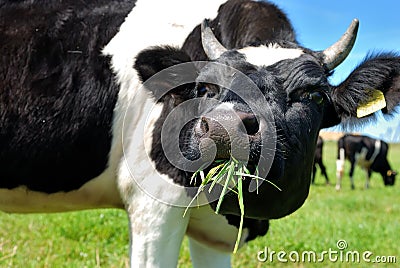
Why cows always chew?

Image result for why cows always chew
   Cows are ruminant animals. That means that they have the so-called four chambered stomach. In actuality, only one of those chambers is actually the stiomach and the others sacs off of the esophagus. 

Grass is an incredibly tough thing to eat because it contains silicon dioxide in it (basically sand) and the cell walls are difficult to process. Most grass-eating species use fermentation to break down the grass.

 Fermentation is the utilization of single-celled organisms like yeasts and bacteria to break down sugars anaerobically (without oxygen). the first chamber of the cow stomach (the rumen) acts as that fermentation tank. The cow chews its food, it enters the rumen and the bacteria take over. Grass being the tough plant that it is does not break down easily, so what the cow will occasionally miz up the contents in the rumen by passing it to the reticulum (the second chamber) and back. When that isn't enough, they regurgitate the food and chew it up some more (called chewing the cud). This breaks the grass particles up further and allows the bacteria more access to the grass to break it down further.

Image result for cows chewing cud 

When it is sufficiently broken down, it is passed down through the reticulum, through the omasum and into the abomasum (the true stomach) - and then it is pretty normal digestion after that.

What is the difference of Sink hole in Blue hole?

What is the difference of Sink hole in Blue hole?

   A Sink hole is a hole in the ground or a surface of the earth that caused by collapsing of the ground, and the Blue hole is like sink hole but happens in a water.

What is a Sink Hole??

   sinkhole, also known as a cenotesinksink-hole, shakehole, swalletswallow hole, or doline (the different terms for sinkholes are often used interchangeably), is a depression or hole in the ground caused by some form of collapse of the surface layer. Most are caused by karst processes—for example, the chemical dissolution of carbonate rocks or suffosion processes. Sinkholes vary in size from 1 to 600 m (3.3 to 2,000 ft) both in diameter and depth, and vary in form from soil-lined bowls to bedrock-edged chasms. Sinkholes may form gradually or suddenly, and are found worldwide.
Related image
What is a Blue Hole?
  A blue hole is a large marine cavern or sinkhole, which is open to the surface and has developed in a bank or island composed of a carbonate bedrock (limestone or coral reef). Blue holes typically contain tidally-influenced water of fresh, marine, or mixed chemistry. They extend below sea level for most of their depth and may provide access to submerged cave passages. Well-known examples can be found in South China Sea (Dragon Hole), Belize, the Bahamas, Guam, Australia (in the Great Barrier Reef), and Egypt (in the Red Sea).
Blue holes are distinguished from cenotes in that the latter are inland voids usually containing fresh groundwater rather than seawater.
Image result for what is the blue hole